Saturday, June 26, 2010

At the Hop

Our retro-tastic 1950s cocktail party was a vibrant, if mellow affair.

There was the booze...


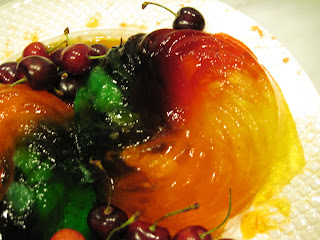
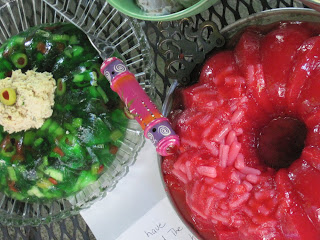
...and the jello.


In rich reds and greens, laced with tuna and dotted with olives, these jiggly gems reminded us of why our (grand)parents drank so many martinis.


The night's winner was probably Fred's mold, which looks like a night's worth of vomit topped by a jujube. Needless to say, only T tried that one. (Brave man, T! And handsome.)

Slightly more palatable, though no less era-appropriate, were the pigs in a blanket, francheezies, tuna noodle casserole, cream cheese and jelly sandwiches, Velveeta fudge, and Judith's chocolate Coca-Cola cake.


The sandwich loaves sounded promising, but it turns out that grape jelly, minced shrimp, cream cheese, bacon, and olives do not mix well.

My mom's was a bit ahead of her time; I call this The Ken Kesey Loaf:


While Dave presented the more streamlined Londoner:


And when we weren't hesitating over the food table, or drinking Fred's handmade Manhattans, martinis and whiskey sours, we were watching Joe and Dee's hilarious beer-can baby.


A good time was had by all. (If not by our stomachs.)


Saturday, June 19, 2010

Waiting on the Cake

It's late, I'm waiting for the half-pound cake in the oven to rise to its golden domed climax (oh my) and rest into its cooling stage before tucking myself in. Tybalt is raging around the room , chasing one of those white bulk bag twist ties that I hoard in the small appliance drawer in the kitchen for reasons unknown even to myself.

Tom and I went to the wine country last Sunday.


Wildflowers, and small grape vines, Gewurtraminer and Pinot Grigio, and dry salami on rosemary crackers in the sunshine. And time alone with T. It was a good day.

It occurs to me, in my baby-addled mind, that these impromptu trips to the movies, the pub, our favorite wineries, will probably disappear when we start making little Waltons next year. Not that I don't intend to haul said tiny Waltons wherever I wish to go, but I need to start savoring these moments with T. Too often we get wrapped up in our lives and I forget to value him as much as I should.

It's been raining again, all week, cool and gray, making this a good weekend to prepare a Father's Day-Parents' 34th Wedding Anniversary feast for my family. I wish the date didn't coincide with Finals Grading Weekend and Theatre Audition Extravaganza (one audition today, call-backs tomorrow, followed by a first read of our summer beach show), but I have the Fennel Honey Pork Loin marinating, the pate fermentee for the baguettes fermenting, the pound cake baking, and a lovely roast beet and carrot salad, mashed potatoes with caramelized fennel and young Walla Walla onion, and a velvety butter lettuce salad waiting to be made tomorrow. My father asked for the homemade bread, roast pork and strawberry shortcake; I am surreptitiously adding beets to the menu to show my family that, when cooked properly and laced with my mom's Italian herb vinegar and olive oil, they can be quite nice.

One day, if I open the Ramona St Keep, I will serve this simple beet salad, maybe adorned with fresh thyme and a soft white cheese. The recipe comes from my CSA farmers, who adapted it from the Chez Panisse Vegetables cookbook. It made a convert out of me, especially the next day wrapped up in a whole wheat tortilla with creamy avocado slices and cheddar cheese. But I eat weird lunches.

The Beets that will Change your Mind

Preheat the oven to 375 degrees. Remove the beet tops (you can save these for another recipe--I chopped and sauteed them, and added them to a quiche), leaving about 1/2 inch stem. Wash the beets and cut in half. Put them into a baking pan with enough water to cover the bottom of the pan. Cover tightly with foil and bake for 45-60 minutes, until easily pierced with a knife. Uncover and allow to cool. Slip the skins off (this is quite fun) and cut off their tops and tails. Cut them into quarters or slices, sprinkle with at least 1 tsp vinegar (the recipe suggests sherry vinegar, but I used my mom's homemade herb vinegar to delicious results) and salt to taste. Let stand for a few minutes to allow the beets to absorb the flavors. Toss with a generous drizzle of olive oil and enjoy, warm or cold.

*If you want to add carrots, as I'm doing tomorrow, simply blanch the carrots in boiling water for around two minutes--until just tender--and cut into chunks or coins.

Thursday, June 10, 2010

Of Grahams and Granola


When I told my friend Julia this evening that I had just made granola, she replied, "If that isn't a stereotype."

Julia lives on the East Coast.

She's a Portland girl by birth, and probably owns more tie-dye than I do (one shirt, which my parents bought for me, okay?), but the stereotype of the dread-locked white chick baking granola to Phish while fragrant waves of Patchouli grace her cleansed-with-biodegradable-food-products skin is strongly ingrained in the popular culture. For an east-coaster--even one with Western roots--the fact that I do not have dreadlocks or scent my house with Patchouli is nullified by the fact that I bake bread, belong to a CSA and utilize (privately) the term "locavore" without cynicism.

Well, sprinkle me with fairy dust and send me to the Oregon Country Fair. Because granola this good is worth the name-calling.


The recipe is Molly Wizenberg's, taken from June 2010 Bon Appetit. I modified the recipe slightly to use cashews instead of pecans and slightly less honey than Molly calls for; granola is both flexible and forgiving. I've only tasted a few of the crumbles--one must eat a real dinner, after all--but I'm already looking forward to breakfast tomorrow. This granola is sweet and wholesome, without the sometimes cloying sugar and rich fats of store-bought varieties.


Tonight's other project--less socially stigmatized but still rarely performed--was to bake graham crackers. I was inspired by Deb's graham tartlets, but didn't want to deal with macerated strawberries and whipped cream. True to recent cravings, I wanted something reasonably simple, with whole grains and a homey flavor.

As you can see above, the little buggers were hard to hold together, resulting in an unhappily patchy surface. (Though the little bears are pretty darn cute. Even with mangled feet.) I followed Deb's recipe exactly, but next time would add a little milk or even apple juice to the dough to make it softer and less dry. The recipe also yielded far fewer cookies for me (10 instead 16), but that might be due to the fact that after a few unsuccessful attempts at rolling out the dough, I resorted to lightly bashing it flat with the side of the rolling pin. The spicing is just right, though, and once baked, the graham crackers are crunchy, buttery and not too sweet, perfect for dipping into tea.

(I couldn't resist.)

Sunday, June 6, 2010

pain au son

Yesterday, after 3 weeks of rain, it was warm and sunny and it seemed like the entire city was outside mowing 2 feet of grass from their front lawns. Arms full of grading, I sat on our back stoop and let my arms freckle, overjoyed with the sun.

And when my work was finished, I walked to the store and came home with bags of tomatoes and green beans and pints of California blueberries, and baked a lemon blueberry tart and a roasted tomato salad.

It all tasted like summer.


This morning we woke up to a steady rain driving past our windows and clattering onto the street. There are pools of water in my tomato and sweet pea pots. The cats are damp again and settle into our laps to dry.

Time to bake bread.

This morning I thumbed through one of my favorite bread books, Home Baking, by husband and wife bakers/photographers/travel writers Jeffrey Alford and Naomi Duguid, and settled on the pain au son. A French bran bread, pain au son is kind of a rustic Branola, with a sweet wheat taste, moist crumb, and crunchy, toasty crust.

I didn't have enough wheat bran for two loaves, so I added an equal amount of raw whole oats, as Alford and Duguin note that they always use oat bran in place of wheat. I also replaced some of the white flour with whole wheat. I like the combination--the oats disappeared into the loaf and whatever the science of it is, the results are soft and sweet on the tongue.

This is a nice everyday bread, to be eaten as toast, or alongside soup, or slathered with peanut butter and eaten as a snack. It tastes like the warm bread served in the dining room of Bascam Lodge on Mt. Greylock, where people hiking the Appalachian Trail stop for a night in bed and the best, simple, warm home cooking. My family used to stay there for a week at a time when I was a kid, all of us in bunk beds, hiking different trails each day and inhaling the kitchen's warm bread and gingerbread pancakes. I haven't been to Mt. Greylock in a long time (and now as a Pacific Northwesterner, the mountain wouldn't look so high), but this bread brought me back.

Pain au Son (adapted from Home Baking)
Makes two very large loaves

4 C lukewarm water
6 T light brown sugar or honey
3 tsp active dry yeast (I used the extra quick rise kind)
1 1/2 C what bran
1 1/2 C raw oats
2 C whole wheat flour
5 C all-purpose white flour, plus some for dusting and adding to the dough if need be
4 tsp salt

Stir together the yeast, sugar and water. Stir in the bran and oats and set aside to soak for 10 minutes.
Sprinkle 1 C of flour over the top and stir in. Sprinkle the salt on the top and stir in. Working 1 C at a time, add the remaining flour to the dough. I use a standing mixer for this, but you could also use a wooden spoon, stirring flour in until it gets too difficult, and then adding the rest as you gently knead the dough.
Once the flour is incorporated (you want a soft, not too sticky dough), knead for 8 minutes, incorporating as little extra flour as possible. I found myself adding a little extra flour to prevent drying, and then adding water to soften the dough, just to add a bit more flour. Just watch the dough as you knead, adding what it needs in tiny increments until you have a large, smooth ball.
Place the dough in a clean, lightly oiled bowl, cover and set aside some place warm for up to 2 hours, until doubled in volume.
Lightly butter two 9X5 loaf pans. Turn the dough out onto a lightly floured surface and give it a few kneads. Let it rest for 5 minutes, loosely covered.
Divide the dough into the two pieces and shape each into a loaf (the easiest way to do this is to flatten the dough into a rough square or rectangle and roll it up from the shorter side, pinching the seam closed as you go). Gently plop each loaf into a pan and cover, letting rise until doubled in volume, about an hour.
Preheat the oven to 375 degrees F. Bake for 50-60 minutes. You'll know the loaves are done with they're a rich brown and you hear a hollow sound when you tap the bottoms. Another trick is to pinch the loaf's corners: they should feel firm. If they still feel a bit soft, pop the loaves (without the pans) back into the oven for 5 minutes.
Let cool on a rack before slicing.
Sunday, May 30, 2010

oatmeal scones


I've been on an oats kick lately, from granola and yogurt to gooey oatmeal pancakes and now these, oatmeal scones with dried cranberries and white chocolate.
I baked these scones this morning, having woken up feeling both energized and defiled by my late night at the Pallas stripper contest. (Don't judge me until after you've eaten these scones.) The experience was so out of my usual orbit that it was necessarily exciting, if a little skeezy. I sat at the table next to my friend Brandee (a Stripper-oke veteran), in awe of what those women can do around a pole. They're athletes, and saying that isn't some hackneyed, post-feminist excuse for an activity that actually debases women (though I saw evidence of that, too)--the core muscle strength, flexibility and grace of the dancers is jaw-dropping. I was startled to find myself at one point with my mouth wide open, staring in unbridled amazement.

Plus, once you've seen a couple of vaginas the nudity gets less noticeable. At least to those of us who have vaginas and find them mildly disgusting at the best of times. But we were talking about scones, right?

So the stripper contest made me want to both jet to the gym to increase the flexibility in my hamstrings and reassure myself that domesticity is not divorced from sex appeal. Hence these seductive scones...and the 9am trip to the gym with T (who's working out to prepare for a shirtless scene in a new movie project--lady readers, keep your pants on).

Nubby and flaky on the outside, rich and dense on the inside, studded with soft raw oats and tangy cranberries and sweet, melty bits of white chocolate, these scones are like a wedge of the best possible oatmeal cookie married with the superlative homemade granola bar. I started with an old Gourmet recipe, but these scones are divorced enough from the originals to be called my own. The significant changes I made were to use self-rising flour with a bit of extra baking soda; dramatically increase the spice quantity and variety; add some wheat bran for fiber, dried cranberries and white chocolate chips; reduce the butter and include a couple tablespoons of organic vegetable shortening to increase the flakiness; and cut them into magnificent craggy triangles, homey enough in look to be comforting and full enough in flavor to be special.

By all means play with this recipe, leaving out the wheat bran or using whole wheat flour, brushing the scone tops with milk, brown sugar and oats before baking, omitting the fruit and chocolate, changing the spicing and making them savory with paprika and cheddar. These are yummy. Bake them and eat them, and do a little sexy jig in the kitchen while no one's looking.


Homey Oatmeal Scones
  1. Preheat the oven to 425 degrees F and line a baking pan with a sheet of parchment paper.


  2. In a bowl or your food processor, combine 1 2/3 C self-rising flour, 1/2 tsp baking soda, 1/3 C wheat bran, 1 tsp cinnamon and a 1/4 tsp each nutmeg and cloves, and 2/3 C brown sugar (I was out and ended up using powdered sugar with no problems). Add 1 1/3 C raw oats and pulse 15 times.


  3. Add a handful each of dried cranberries and white chocolate chips and mix well.


  4. Cut 1 cold stick of butter and 2-3 T of vegetable shortening into 1 T pieces. Add to the flour mixture and pulse until the texture resembles cornmeal with a few pea-sized lumps of butter. You can also do this with your hands or two butter knives.


  5. Gradually add in 2/3 to 1 C milk, buttermilk or cream. Pulse or hand mix until just combined. You want the mixture to be moist enough to hold together, but not wet. The dough shouldn't stick to your hands when you pat it out to the shape the scones.


  6. Dump the shaggy mess onto a very lightly floured counter top and knead a few times. Don't over-knead unless you like very dense pastry.


  7. Pat the dough into a thick circle (maybe 8 inches across and 1 1/2 inches high) and cut into eight triangles. Place the scones on the sheet with a little space in between them. Bake for approximately 16 minutes, or until a toothpick inserted into the middle of a scone comes out clean.


  8. Let cool to warm and enjoy. I like these without butter or jam, but I'm sure they'd be lovely with salty butter or a dab of marmalade.


Sunday, May 23, 2010

May Storms

It has rained for eight straight days. And that may be a conservative estimate, because I can't quite remember the last day yellow light filtered through our blinds to create sun spots for the cats to sleep in. Instead the felines have chosen my lap as their primary source of heat, a decision that wavers (in my experience of it) from drowsy and comfortable to please get this wet cat and her muddy paw prints off of my laptop and out of my water glass.

I'm exaggerating a little--not about the cats--but about the rain. Not about the rain's duration, either, but about my unhappiness with the sun's vacation from Portland. Truth be told, I like the rain, and the stormier the better. The weather suits my inclination to cook and bake, read and write, and watch back episodes of Survivor in the early weekend mornings with Tom. I do miss running around outside, biking and pulling grass shoots out of my plants, and grading in the sun, but since I'm not an X-Man and have no control over the weather (I know! You're shocked!), I can be patient and appreciate the gray sheets soaking my strawberries and encouraging me to drink one more cup of tea before getting up to do something more productive.

So it is that I find myself on Sunday evening, after a mellow day that started early with the gym and will end late with the finale of Lost--filled in the middle by oatmeal pancakes with blackberries and warm maple syrup, reading and working, baking cranberry walnut bread, starting my first batch of yogurt, and a simple solo dinner of wheat berries, red chard braised in (T's amazing) tomato sauce, and a creamy poached egg--sitting on the couch with a damp cat and a computer on my lap, about to dive into the first of Robert Jordan's endless fantasy series.

For the readers who don't know this already, I harbor a secret love for (good) fantasy novels. I came to this self-realization late, when T thrust a Robin Hobb novel into my arms and said, This will change your mind. (It had been a pretentious, dismissive mind.)

It is now a more flexible one.

If you like Grimms Brothers' fairy tales (enough to have read them as an adult) and The Princess Bride and bildungsroman and the dubious authenticity of the Arthurian Legends (and dragons, princesses and magic), you will like fantasy novels. They're fun and expansive worlds, especially in the hands of character-driven authors like Hobb and George R R Martin (though curse you, Martin! For failing to finish the Sword of Thrones series, and for leaving us hanging with a book covering the exploits of the least exciting characters). I've read some Terry Goodkind, too, but a few books into his series I tired of his lovers kept apart by destiny fighting a never-ending stream of evil plotlines. I watched Buffy for that, you know? Give me something with a little more to chew on. Give me less obvious allegories for modern-day struggles.

(So, I am still a little pretentious and dismissive. But I believe in standards. Even brain candy should contain a few nutrients.)

So. Yes. The rainy gray evening and the less damp cat and the more damp sweater and the glass of water with an unmistakable trace of mud. And the book.

I don't really mind the rain.

Sunday, May 16, 2010

Classic Crumb Cake, like Papa Used to Buy

When I was little we used to go to my grandparents' house on Sunday mornings for brunch, and if the weather was warm, an afternoon of swimming in Wincoma Bay. The brunches were typical Long Island Jewish affairs, with piles of fresh, chewy bagels, the whipped cream cheese I loved because we only ate it there, my Papa Lenny's herring (still an object of horror), lox, tomatoes, and onion slices. And those bagel sandwiches were really, really good...

But nothing beat the crumb cake.

If you've never eaten New York crumb cake, picture a thin slice of cake covered in at least 1 1/2 inches of dense brown sugar-butter-cinnamon crumbs. To be truthful, the cake part was never that spectacular; the typical slice crumbles into dry, tasteless pieces as soon as it makes contact with your mouth, causing minor choking problems. But we endured the cake in order to put off the slow, extravagant eating of the rich crumbs, trying to make them last just long enough to make our siblings jealous but not to invite the attention of our dad, who is an unethical eater when it comes to his favorite treats. ("Let me show you how to lick that ice-cream cone." "Can I see that cookie?")

So why does this admittedly flawed cake incite so much pleasure? In part the memories amplify its deliciousness and downplay its flaws, especially since my grandpa passed away, but it's also because the cake has potential. The crumbs are already delicious, right? So all that remains is to turn the bland cake into a lush crumb accompaniment.

Abigail Johnson Dodge does just that in The Weekend Baker, which, by the way, is totally worth the purchase. It's full of fast and delicious homemade goodies that you can whip up at 7am the morning of a birthday brunch because you kind of forgot to make something. I mean, who does that, though?

Dodge's cake is soft and subtly flavored with vanilla, which is a nice counterpart to the spiced topping. It just gets better as it ages, too, because the crumb top softens and solidifies into a rich mass (it's a lot more appetizing that it sounds) and the cake gains a certain density. The only alterations I made were to add an extra bit of cinnamon, use only brown sugar (and to reduce the amount slightly), and to just barely reduce the amount of melted butter, which is pretty extravagant.

The 9x13 cake will feed a small breakfast army, so make this for the people you love. And eat it with them.

Classic Crumb Cake (from The Weekend Baker)

  1. Preheat oven to 350 degrees F.
  2. Melt 3 1/2 sticks butter (yeah, I know) in a small saucepan. Set aside 3/4 C for the cake.
  3. To make the topping: Mix the remaining butter (16 T) with 3/4 C brown sugar, 1/2 C granulated sugar, 1 1/2 tsp cinnamon, 1/4 tsp nutmeg, pinch of salt , and 2 2/3 C flour in a large bowl. Set aside.
  4. To make the cake: In a large bowl, mix 3 C flour, 1 1/4 C granulated sugar, 1 1/2 tsp baking powder, and 1/2 tsp salt. In a separate bowl, combine the reserved butter (12 T), 1 C whole milk, 2 eggs, and 2 tsp vanilla extract. Add the wet ingredients to the flour mixture and mix until just combined.
  5. Pour the batter into a lightly greased 9x13 baking pan. Sprinkle the crumb mixture over the top in an even layer (it will be quite generous).
  6. Bake for about 40 minutes, until the cake springs back when lightly pressed and a toothpick inserted into the center comes out clean.
  7. Let cool before eating. And, if you can wait, don't eat it for a few hours. It just gets better.